Sunday, March 1, 2020

My lovely Chinese friends


In the late 1960s, Peoples’ Publishing House, in Colombo, advertised a list of Chinese periodicals at bargain prices, and I dropped in and bought a subscription to China Pictorial, a large, colorful, monthly magazine. The annual subscription was only Rs. 10, and even I could afford that!


In those days of black-and-white newspapers and magazines, when most news stories came from the West, China Pictorial was a welcome change. Filled with colorful, large photos of dancing troupes, farmers in their fields and fish ponds, young “pioneers” in red scarves, soldiers and ballet dancers in heroic poses, steam powered trains and their drivers, and - the main attraction for me - young, smiling, Chinese women, all in pigtails. It was pure propaganda, of course, but I had no inkling how this knowledge would come in handy 40 years later.

Shumin
The first Mainland Chinese person I met was Shumin, in 1984, when I was a graduate student at a US university. When she joined our program, she became a star attraction being the very first student from the Peoples Republic on campus. Her vivacious personality and natural curiosity about anything American also drew people to her.
I recall taking her on a tour of the neighborhood supermarket and seeing her startled expression as we strolled through the pet food aisle. Seeing all the pictures of cats and dogs on the can labels, she asked me “Do Americans eat cats and dogs?” Pet food was unknown in China. She was amazed by all the red meat displayed, and said they could only buy the fatty cuts of pork in China, the red meat going to Communist party cadres.

We became friends, and she opened up about the hardships of life back home. Hers had been a well to do family, but her father was labeled a counter-revolutionary and imprisoned after the Communist takeover.  His crime: during World War II, he had worked for a foreign outfit, never mind that the outfit had fought the Japanese in defense of China!  The family became poverty stricken, and Shumin was ordered to the countryside to work in a farm. Her task was to carry excrement to the fields (to be used as fertilizer) on two baskets slung on a pole balanced on one shoulder. (Not quite the propaganda I read in China Pictorial.) Shumin overcame these hardships, became an English teacher, and managed to come to the States. That alone is an incredible story.

Hong Kong
In 1995, I came to Hong Kong to teach at a university. The local population was 99% Chinese, but they were Hong Kongers, distinct in their dialect, Cantonese, and mostly Western in their thinking and lifestyle. The British handed back Hong Kong to China two years later, and the first students from China enrolled at the university a couple of years later.

The Mainland Chinese students entering the English department were older, and a few were full professors at their universities, but lacked doctorates. From being respected professors, they became students overnight on coming to Hong Kong. A few found the transition difficult. One, John, assumed the doctorate would automatically be his because he had authored an “important” book in China. He went about grumpily for weeks after he was firmly told to take courses, conduct research, and write up a thesis under supervision.

These students spoke Mandarin, not mutually intelligible with the Cantonese dialect spoken in Hong Kong. Hong Kongers generally regarded Mainlanders as poor, backward, wicked Communists. In return for the stipend they received, these students had to work as research assistants (RAs) and teaching assistants (TAs) to professors. Some undergraduates complained about the incomprehensible accents of the Mainland TAs, although I didn’t have a problem with their pronunciation.

Life was hard for these Mainlanders. Adjusting to life in Hong Kong - with its capitalism, personal freedom, high cost of living, and general use of English, and the prejudice they faced - was a daily challenge. The stipend, although more than double what they earned on the Mainland, didn’t go far in expensive Hong Kong. They lived under tremendous pressure, given only 3 years to complete their research, write-up the theses, and complete the doctorates while also working as RAs and TAs.

In the English department, all the other professors were local Hong Kongers or expatriate Westerners. I was the exception, and when they realized how much I knew about China (China Pictorial and Shumin’s life story coming in handy here), they were amazed. I also regaled them with accounts of Ceylon’s recognition of the Peoples Republic as far back as 1950, despite strong objections from the USA, the Rubber-Rice pact between the two countries, and of their beloved Premier Zhou En Lai’s triumphant visit to Ceylon in 1957, when he addressed a vast audience in pouring rain, and, taking off his jacket, climbed all the way to the top of Sigiriya.

I could relate to them because I, too, had struggled as an older graduate student, surviving on stipends. So, I developed an empathy for John, Serena, Spring, Ellen, Sheila, Lillian, and Susan. (English majors in China take-on an English name.) Some walked into my office seeking advice on academic matters, on coping and surviving in this milieu, and occasionally to pour their hearts out. They missed their families, especially the children. Knowing they rarely had a decent meal because of rudimentary facilities at student hostels, I took two or three of them for lunch at the Senior Common Room occasionally.

At lunch, I brought up topics such as the Great Leap Forward, and the devastating famine that followed, the Tiananmen incident, how they reacted to Hong Kong’s return to China, and their views on current leaders. Although I probed, they were not very responsive, perhaps not trusting each other enough to speak their minds. Once, when I mentioned the Sino-Indian conflict, John was surprised, asking “Did China and India have a war?” They had never been told about it. I was scathing in my criticism of Mao, and all the deaths he had caused. Later, I came to know that all except one student were members of the Chinese Communist Party.

I remember two incidents vividly. One day, John came into my office, closed the door behind him, and, in a conspiratorial whisper, asked me where he could attend Catholic mass; he was a secret Catholic, a persecuted group in China. I told him that the campus had a Catholic chapel. Another time, at lunch, we were talking about the brutal Cultural Revolution, and I asked Serena how it had affected her. Without batting an eye, she said “My parents committed suicide”. The rest of the meal passed in stunned silence. I learned that her parents, both teachers, had been publicly humiliated and tortured by Red Guards, who happened to be their own students. They couldn’t bear it any longer.

With doctoral students, one goes beyond teaching and thesis supervision. So I authored an academic article with one of them, and took two more to academic conferences abroad, to make joint presentations. I published another in a journal I edited, and listed my favorite student as the second author of a text book I wrote. All this was to give them a head start, so that when they returned to China, they would have enhanced recognition as academics and the self-confidence that followed.

Then, they began to invite me to China.

In the Mainland
Although I had lived in Hong Kong for more than 5 years, and traveled widely for academic purposes and tourism, I had not crossed the border into the Mainland. For one thing, not many people in China spoke English, and I didn’t speak Mandarin. Also, I needed clean toilets, and China’s had a terrible reputation.

Nevertheless, I was curious about what lay beyond the “bamboo curtain”, the China I had read and heard about so much. Surprised that I had never visited China, one student invited me and said she would come along as the guide, and my wife and I took the plunge.  First to Beijing, where we walked on the Great Wall, toured the Forbidden City, Tiananmen Square, the Summer Palace, the Hutong courtyards, and other well-trodden tourist sites, visited a nearby cherry orchard, and met with other students who was visiting from Hong Kong. Then, we took our first train ride in China, to Jinan in Shandong province.  We traveled on a crowded, old fashioned train, where an attendant went around serving hot tea from a flask. Along the way, I caught a good view of the legendary Huang Ho, the Yellow River, which I had read about in school textbooks.

During this trip, something remarkable happened. I was now their guest, and a hidden feature of their personalities began to emerge. These students were steeped in Confucianism, with its emphasis on filial piety and deep respect for elders and teachers. (I qualified for the latter two!) They smothered us with affection, “shadowing” us from the moment we emerged from our hotel room in the morning, guiding us through the Chinese menus during meals, helping us to get on and off from vehicles, shielding us from touts, and sitting close-by during travels so that they could answer our numerous questions. They were loving to my wife, not letting go of her hand, knowing that she had recently come through a serious illness. Never have we been pampered so much.

In Shandong Province, we visited Quifu, the birthplace of Confucius, and were taken up Taishan mountain by cable car. After 10 days, when we left for Hong Kong, we were loaded down with gifts.


China now had an open economy, prosperity was rising, but its effects were not yet felt at universities. The teachers’ salaries were still low, and they had to take on time-consuming additional work to make ends meet. They lived in rather old apartments provided by the universities, and some still rode bicycles to work. The libraries, perhaps due to censorship, had pitifully few books in English.

As more students returned from Hong Kong to their universities, with brand new Ph.Ds. in hand, I began to be invited to speak at academic conferences on the Mainland. I gave keynote speeches in Beijing, Shanghai, Jinan, Wuhan, and Shantou, and also conducted workshops. When I landed at the airport, a smiling former student, now a friend, would be there to greet me, and taken to a hotel in a grand official car. Usually, one or more graduate students would be asked to “shadow” me, spending almost every waking hour with me during the visit.

During these trips, I was taken to nearby tourist sites. I had already seen Beijing and Qiufu, but recall being driven along the beautiful Red Lake in Wuhan to visit Mao’s summer residence, a memorable stay in Yunnan’s magical Lijiang town, and boating on the Yangtze River in Shanghai. Numerous trips to museums and scenic sites were added on, and shopping, when my wife was with me.


Many authors are banned in China. One is the Chinese-American Ha Jin, whose best-selling novels include Waiting and War Trash. So, when I travelled to China, I would take a few paperback copies of these books and distribute them to the literature professors, to their delight. My bags were never searched at Customs.

On my repeat visits over the years, I began to notice the rising prosperity of my friends. John had received a huge “joining fee” when he moved to another university, and showed off the beautiful apartment he had bought with that money. Other friends were buying expensive cars, more apartments as investments, and sending off their children overseas to the US and Europe for higher studies. Restrictions on traveling abroad were being eased, and some were spending up to a year at US universities on exchange programs.


My last trip to China was three years ago.  I started at Hangzhou, at a huge English teachers’ conference, presenting a keynote and promoting a textbook I had coauthored with two Mainland friends. For the first time, I would be taking China’s new high speed trains to Jinan and onto Beijing. These trains, sleek and comfortable, reached speeds up to 350 km. per hour, and were as good as the bullet trains in Japan. In Jinan, my favorite student, now a top official at her university, was at the station to meet me. The next day, I addressed a large audience in a packed auditorium, and left for Beijing the following morning, to be greeted by another friend. Another talk to a standing room only audience followed. Such audiences are gratifying because I was long retired and no longer active in academia.

On the flight back to HK, I thought about my visits to China over the past 20 years. I had seen the country change beyond belief. Streets that were crowded with bicycles were now jammed with cars. The baggy, ill fitting clothes of the masses had been replaced by fashionable clothes rivaling those of Hong Kong. Passports, issued only to trusted Party faithful, were now available to almost everyone. Millions were traveling abroad. Chinese parents would spend up to half a million dollars to enroll a son or daughter at a top American university.

But, what I treasured were the more personal memories. Riding a bicycle around the lovely Tsinghua campus in Beijing, with my wife seated on the crossbar; walking around in Jinan, and suddenly coming across a magnificent Gothic-style Catholic cathedral, built over a century ago; being shown around the beautifully landscaped cemetery in Qiufu, where Confucius and his descendants are buried; floating down the Li River on a bamboo raft amidst the soaring karst hills; taking a three-day hike along the lonely Tiger Leaping Gorge; seeing Mao’s vast bed at his summer home in Wuhan, with its huge pile of books, and watching the upper Yangtze river in Yunnan, its swirling waters rushing past.


Postscript
After the Easter Sunday bombings in Sri Lanka last April, I received text messages and e-mails from my friends in China, worried about my safety.

Now, with a mysterious virus spreading in China, it was my turn to be concerned. Only a couple replied, briefly, one in Wuhan saying “The situation here is very serious, I stay at home all day, dare not even go downstairs.” The other friend, from another region, wrote I am now staying at home all the time, being busy with textbook compilation. So my family and I are all safe.” During this time of tight censorship in China, perhaps their emails are monitored, and I, with my Western name, may land them in trouble by contacting them again.

So I worry about my lovely Chinese friends.

Friday, February 14, 2020

Any Excuse the Bash the West - Letter published in Sri Lankan newspaper


On Thursday February 6, 2020, The Island newspaper carried an article titled “Stop harassing the Chinese”, which quoted at length a statement issued by the Sri Lanka-China Friendship Association. It criticized the mistreatment of Chinese visitors in Sri Lanka and asked Sri Lankans to act with humanity and compassion.  All well and good.

But, what disturbed me was the following statement: “the western media has done its best to create a fear psychosis”. And here’s why.

Before I get to my point, let me explain why I am keenly following the coronavirus outbreak in China and Hong Kong. I lived and taught in Hong Kong for 20 years, and still keep in touch with some former students who have themselves become academics in Hong Kong. I also taught more than one hundred students from Mainland China, and am in contact with a handful of them. I worry about them. I went through the SARS outbreak in 2003 while living in Hong Kong, and experienced the fear that gripped the city and the economic collapse that followed. SARS arrived mysteriously in Hong Kong because Mainland China did not disclose the spreading virus in nearby Guangdong Province, and 299 innocent Hong Kongers died as a result.

I ask my readers to glance at the following excerpts from the same daily newspaper over a two-week period:

1.     “Hong Kong infectious disease experts are urging the government to take draconian measures against the spread of the deadly new virus from the mainland Chinese city of Wuhan, citing research estimating that 44,000 patients could be infected there – far higher than official figures of 2700.” (January 27)
2.    “The official number of coronavirus cases in Wuhan might not reflect the true scale of the crisis as there may be many patients who are undiagnosed and not reported, medical experts said. Given that there is also a shortage of coronavirus testing kits, the figure could be much higher than it actually is.”
3.    “Professor David Hui Shu-cheong, a respiratory medicine expert from Chinese University of Hong Kong, said the official tally in Wuhan could be ‘just the tip of the iceberg’ because it only reflected the acute cases where patients were admitted to hospital.”
4.    “Li Lanjuan, a member of the (China's) National Health Commission’s expert panel on the coronavirus, told state broadcaster CCTV on Monday that since there were not enough testing kits in Wuhan, ‘not everyone can get tested’.”  
5.    A doctor at the Union Hospital in Wuhan, who declined to be identified, said staff could only test about 100 patients a day, and they had to wait 48 hours for the results. ‘When the National Health Commission announces the numbers, they’re already two days old,’ the doctor said. ‘We also have to turn away patients with mild symptoms, knowing that many of them will return later [when their condition worsens]. But we don’t have the space in the testing centre, or the hospital beds.’”

I could go on.

These news items and dire warnings did not come from the Guardian, the Washington Post, or The New York Times. They are from Hong Kong’s South China Morning Post (SCMP), which, by the way, is owned by Jack Ma, the founder of Alibaba, a loyal Mainland Chinese citizen and a card-carrying member of the Chinese Communist Party. This is not fear psychosis generated by western media.

SCMP reports that, this morning, Dr. Li Wenliang, 34, passed away in Wuhan. On December 30, Dr. Li informed his medical classmates on an online chat group that several patients with SARS-like illnesses were quarantined at a Wuhan hospital. He was subsequently summoned to the local police and forced to sign a letter promising to make no further disclosures. “CCTV, a Communist party mouthpiece” according to SCMP, accused Dr. Li and of spreading “rumors.” Dr. Li, while treating his patients, himself contracted the coronavirus resulting in his death.

Dr. Li
A major health crisis is raging in China, and today’s “official” cases number 29,275 and the death toll is 638. Going by all I have read, the actual figures may be very much higher. This is the time to take every precaution in Sri Lanka, such as cancelling all flights to and from China, and not time to bash the West.

George Braine

Those pilgrimages to Madhu church


Some friends recently completed a day trip to Madhu, a 250km roundtrip from Negombo, leaving at dawn and returning by late evening. They were boastful of this “achievement”, made possible by a fast, auto drive, air conditioned, power-steering car, on well paved roads, helped by “hotels” on the way where they could pause for tea. But, they have no idea of what they were missing on such a quick trip.

My father, the youngest of nine children, wrote about his trips to Madhu as a child. This was in the 1930s, and his English father had bought a Galloway saloon car for the family. He even remembered the registration number: S-264. His Sinhalese mother (my grandmother) was a devout Catholic. The pilgrimage to Madhu, an arduous journey through dangerous jungle, to a shrine reputed to have miraculous powers, was expected to bring many blessings. Their annual trips to Madhu were made in the Galloway. It bore a load of 10 passengers (not all the children may have traveled every year), grandmother seated in front alongside the driver, and everyone else in the backseats. Pots and pans, mats, pillows and provisions to last a week, were all tied to the luggage carrier at the rear and stacked high over the hood of the car.


I had never seen a Galloway, so had to Google for an image. Father did not mention the hardships of the trips, only that they prayed and sang hymns on the way. Horseplay and any type of misbehavior was frowned upon – this was a pilgrimage, after all - but, being boisterous children, I am sure they were up to all types of mischief.

In the early-1960s, we did a few trips to Madhu, first in a 2-door Ford Anglia, later in a 4-door Ford Prefect, both clunky, compact cars.  (Come to think of it - from a Galloway to a Ford Prefect - shows how much my family’s fortunes had declined in 30 years!) Father drove, with mother in front, and three children and a domestic helper in the back. We were jam-packed and loaded down with clothes, pots, pans, pillows, mats, provisions for a few days, and other essentials. No auto drive, power steering, or even a car radio, and heading into the hot and arid Wanni without air conditioning. Compared to now, the roads, though tarred, were narrow, uneven, and cluttered with potholes.


In the 1960’s, import controls were strict. So, we only had rebuilt or retreaded tires and locally turned out spare parts. Without coolants, the water in the radiator would boil over on longer trips, damaging the hose pipes. Bullock carts were common on roads those days, and a constant nuisance were iron nails that fell off from the “ladan” on the bulls’ hooves. Flat tires were frequent, and when the tubes were pulled off from the tires for repair, I recall seeing numerous roughly vulcanized patches, like spots on a leopard.
We traveled in October, when fewer people visited Madhu. In preparation for the trip, mother made sweetmeats like “aluwa” and “kaludodol”, and father had the car serviced along with an oil change. He also managed to borrow a tarpaulin for the tent under which we would camp.

Our route was through Chilaw, Puttalam, Anuradhapura, and then to Madhu on the Mannar Road. The road up to Puttalam was through populated areas – villages, small towns, paddy fields, coconut plantations – and paralleled the railway track at times. Passing Chilaw, we stopped at the Deduru Oya, to sit on the sandy banks and enjoy the lunch parcels, wrapped in banana leaves, that mother had prepared. The road was fairly straight, often shaded by spreading “mara’ trees, and, after Mundel, went through low lying, brackish areas, scrub, and the lagoons. The salterns were nearby.

Passing Puttalam, the landscape suddenly changed: we entered the jungle, the large palu, weera, tamarind, and other trees stretching their branches across the road, forming a shady canopy.  A mongoose would suddenly dart across, or a snake slither along, but we rarely saw larger animals. But, we knew they were there; the Wilpattu national park was to our west, and it was home to elephant, leopard, bear and wild boar. Except for the occasional vehicle going in the opposite direction, and bullock carts which we passed, we hardly saw any sign of humans.


The double-bullock carts, each pulled by two strong bulls, were carrying huge loads of woven coconut fronds for sale in the Wanni, to be used for roofing. Most carts had a spare bull that was tied to the end of the cart, and another carter, who would walk behind the cart or could be seen lying on a rough hammock (“goni padanguwa”) slung under the cart. These carts traveled in groups, for safety, both from wild animals and thieves. As we passed them, we could clearly hear the tinkling sounds made by the necklace of bells (“gejji”) around the bulls’ necks, and the clop clop of their iron shod hooves on the hard road.

My parents were familiar with the jungle. They had both worked at Galgamuwa, a small settlement with a railway station, a rest house, and government offices in the midst of thick jungle. In fact, they were married there, and I was taken as an infant to their modest, thatched house. Father had been a keen hunter. Their familiarity also meant that they knew the hidden dangers of the jungle.


To let some fresh air in, we rolled down the windows, although the air that blew in was oven hot during early afternoons. To pass the time, we recited the rosary, prayed, and sang hymns and popular songs of the day.  C.T. Fernando and Chitra+Somapala were our favorites, and C.T.’s “Barabage”, about bullock carts, was sung with gusto. I think these trips were the most joyous times we shared as a family.

The endless jungle would be broken when a crude wattle and daub hut, with a thatched roof, appeared suddenly alongside the road. A slash and burn “chena” plot would be at the back, and a small “messa” with a few vegetables and cobs of corn offered for sale, in front. Even at my young age, I realized that the lives of these inhabitants were cruelly hard, and passing vehicles their only distraction. Their nights would be fearful, sometimes terrifying, being surrounded by the dark jungle and wild animals.

Driving after dusk was dangerous, because the wild animals wandered onto the road. We usually stopped at Kalaoya or at Anuradhapura. At Kalaoya, a lovely little church sat by the river, more of a stream, not far from the road. We unloaded the mats and bedding from the car, and mother set about preparing the night meal. We had a single-burner kerosene stove, but gathered a few sticks of firewood for a second hearth, so that a couple of curries (“parippu” and “karaththa hodda”/carter’s curry) could be cooked quickly. The latter, the staple curry traveling carters, consisted of dried sprats, potatoes, onions, and a touch of chillies in a light gravy. It became my favorite, and till she passed away years later, my mother prepared it for me every time I visited Sri Lanka.
After the meal, we would go down to the stream to wash the pots and plates, and perhaps for a quick dip in the stream. Mats would be laid on the side verandah of the church, and a little light came from the sooty hurricane lanterns we carried. We may have been bitten raw by mosquitoes, but I don’t remember it.

The following morning, after a quick breakfast of bread and pol sambol, we started early on the final leg of the journey. We passed through Nochchiyagama, which, if I recall correctly, had a petrol station, where we fueled up and also refilled the spare cans of petrol. Then, to Anuradhapura, from where we turned west onto the Mannar road. Except for Medawachchiya, a railway town, I can’t recall a large settlement till we reached Madhu church. What I do recall is that we would see more Tamil people and little settlements with Tamil names.

The thick jungle crowded from both sides, and traffic was even less. We once had a dreaded flat tire. Because the car was too heavy to be jacked up, it had to unloaded. While we worked feverishly, a passing lorry stopped, and the driver and his assistant (“cleaner’) came to help, saying “methene ali maruwena thenak” (elephants cross here).

We turned right at Madhu Road junction, which had a railway station, and travelled up to the church area. Our first task was to drive around till we found a suitable spot to camp, where the ground was flat, trees to tie the tarpaulin were available, and the jungle would be nearby, because we would not use the filthy public toilets. As soon as we began to unload the car, people who had already camped nearby would come to help, and we soon had our tent up. This would be our temporary home for 3 or 4 days. 

Even at Madhu, the people from Negombo, Moratuwa, and Chilaw camped together, forming small communities and apparently finding safety and happiness with familiar faces.

Not all the pilgrims came by road. Special trains to Madhu would set off from Catholic areas like Negombo and Moratuwa, packed to capacity. From what I heard, most families had a great time, with their relatives and neighbors traveling along with them.

We children wandered all over the church surroundings, curious about other pilgrims and how they managed under the harsh conditions. I don’t recall any grocery stores, so all supplies had been brought from home. Sleeping, cooking, and washing facilities were rudimentary, and people improvised in every way they could. For bathing, we went to common wells, and poured water over our bodies using small buckets.

The happiest instances were when we met schoolmates from back home, and walked round in small groups. We visited each other’s camps, to be lavishly served with various delicacies brought from home. We dropped in at the church, where people were continuously reciting the rosary and prayers. We also visited the stalls that sold all sorts of trinkets and sweetmeats, more to see than to buy, because we barely had any pocket money.
Those times at Madhu were our opportunity to mingle with the Tamil community that had come from the North, East, and the Mannar area. The cooking aromas from their camps were different, and so were their clothes and the language.

More than 50 years later, some months ago, I returned to Madhu, traveling comfortably in an air conditioned car on well paved roads. We did not have to travel via Anuradhapura, because the driver took a short-cut after Nochchiyagama which brought us directly to the Mannar road.

But, it was heartbreak most of the way. The verdant jungle I knew was gone, except in forest reservations and teak plantations, the latter absolutely of no use to animals. The settlements that had taken their place appeared to be struggling. The human-elephant conflict was apparent from the elephant wires in some areas, and also from makeshift huts and houses that had been destroyed by elephants. The decay was worse along the Mannar road, which had also suffered the ravages of the war with the LTTE. A section of jungle would be cleared, the lumber sold, a hut built to claim ownership, and a few pitiful vegetables planted. Many of these huts were then abandoned, the settlers perhaps moving to another section of jungle to destroy that, too.
But Madhu church, which had been damaged during the war, had been beautifully restored by the army. I walked around, recalling the times I had visited with my family. My younger brother was long gone, and so were my parents, but the memories remained.


I could have returned the same day, but did not, for old times’ sake. Instead, we spent the night at a nearby hotel.

Wednesday, February 12, 2020

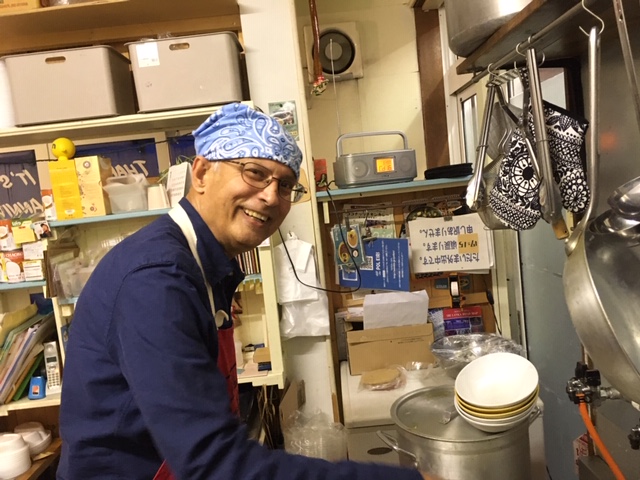
Chef George at POL KIRI


Chef George at POL KIRI

When I travel around Sapporo, in Japan, I keep an alert eye for English wording that appear on shop signs. They often make no sense; the syntax and semantics are intriguing, to say the least. But, they do provide me a with few delightful minutes of speculation, wondering what on earth they mean. My favorite is “Freaky Wardrobe Coffee”. Now, I ask myself, why is the wardrobe freaky? Is the wardrobe in the coffee shop? Does the shop sell coffee or wardrobes and coffee? Finally, dying with curiosity, I went there one day, and, passing a sign that asked “Are you freaky?”, found it to be a retro 1960s place, which served average but expensive coffee, where young women came to linger and take photos of the displayed artifacts. The manager could not explain how they came upon the name. Perhaps to sound “cool”?

Some months ago, a friend’s elderly father was being transferred to a rehabilitation hospital, and I rode with him in the ambulance. As usual, my eagle eye was on the shop signs and we passed one that said POL KIRI. Did I really get that right? Was it something Japanese, or Sinhalese?


So, curious as ever, we stopped there on our way home. Indeed, it served Sri Lankan chicken curry with rice, and, of course, POL KIRI on the sign meant coconut milk. I expected to find a Sri Lankan running the place and was surprised to be greeted by a Japanese woman, Yoshiko. It was a tiny unpretentious place, with the numerous handwritten signs and sketches that adorn such eating places and bars in Japan. They are run by the owners themselves, who cook, serve, and clean-up. They usually have a small but regular, loyal clientele.

I saw a roughly sketched map of Sri Lanka on the wall, where Nuwara Eliya was shown in the deep south where Hambantota is! Yoshiko was delighted to know I was Sri Lankan, and, with my friend translating, the POL KIRI story unraveled. Her husband, while working in New York, had befriended a Sri Lankan, who later visited Sapporo and taught them to cook a few Sri Lankan dishes. From that was born the idea of opening a place serving Sri Lankan curry, which of course needed pol kiri.

Let me digress here and describe what “curry” means in Japan. The sauce or gravy is made of basic Indian spices, made thicker by the addition of flour, and served with potatoes, onions, carrots and meat.  Coconut milk is not an ingredient. Curry restaurants and “soup curry” places are ubiquitous in Japan and are quite popular, especially in winter. So, POL KIRI was special: it served curry in the Sri Lankan style, with coconut milk.

The menu had only three items, Sri Lankan chicken curry (very spicy) and coconut chicken curry, both served with sticky Japanese rice, and coconut flavored ice cream served in a coconut shell. I learned that Yoshiko’s husband had a full time job but helped with the cooking. The day to day running of the place was in her hands, and she opened POL KIRI for lunch five days a week, Monday through Friday, and also for dinner on Friday. On my first and a few more visits (it was a 30-minute drive from home), I did not see more than two or three customers at a time.

Obviously, POL KIRI did not serve a large clientele, but it had lasted five years. They bought the canned coconut milk online from Amazon, and spices were sent from Sri Lanka by their friend. They had never been to Sri Lanka; the erroneous map was an obvious clue.  (I later gave them a detailed road map of Sri Lanka, which has replaced the previous “map’ on the wall.)

On subsequent visits, Yoshiko’s welcome on seeing me was obvious; perhaps she was happy that an actual Sri Lankan enjoyed her curries. She had a childlike quality which was charming: when I took a Sri Lankan dancer as a gift, she asked me for a name. I said Chandra. When a tiny wooden elephant was gifted, it was named Raja. Each time I walked in, she introduced me to other customers as a Sri Lankan; perhaps my visits authenticated her curries.

Takashi, her husband, is an interesting character. He had spent some time in the States, spoke good English, and played in a Bebop band, jazz being popular in Japan. I only saw him when I went for dinner on Fridays, and we chatted. Once, he proudly showed me a large cooking pot, empty, saying “Sold out”!

I was moved by these gentle, charming people. Here, in the remote northernmost island of Japan, where the people barely knew of Sri Lanka and which hardly any Sri Lankans visited, Yoshiko and Takashi were keeping a little bit of my culture and cuisine alive. So, I wondered what I could do for them, and the idea for a Sri Lankan Night was born. I would cook two curries, provide pappadam and basmati rice, all for no charge because I would be having fun. They loved the idea, and Takashi undertook to cook a few more Sri Lankan dishes. The guests would be limited to 15. We would have Sinhala music, and decided on the last Friday of the month, January 31.

I went home and ordered some items, such as parippu, basmati rice, and pappadam, on line. A few days later, on checking POL KIRI’s Facebook site, I saw that the Sri Lankan night was posted there, with the appearance of “Mr. George from Sri Lanka” noted, along with a neat sketch of the menu, done by Takashi. Would the readers think that Mr. George was a famous Sri Lankan chef? I could handle a few dishes, and had never cooked for more than 5 people. The night was going to be interesting, to say the least.


When the time arrived, I put on an apron, tied a bandana around my head in the style of a Japanese chef, and entered the small kitchen. Takashi has already finished his cooking. The guests began to arrive, two couple driving more than 100 kilometers roundtrip. Only one guest had been to Sri Lanka.

I had sprinkled maldive fish lavishly on the parippu and the cabbage and potato dish I prepared, and the aroma was good. Takashi surprised me with amazingly authentic black pork curry, brinjal moju, and pol sambol. He had polished his skills by watching YouTube on Sri Lankan cooking. On each serving, the long grained, snow-white, fluffy basmati rice was colorfully surrounded by the curries, including the usual chicken curry and pappadam. So, while a soft snow fell outside, and Victor, Amaradeva, and Clarence played in the background, we had a memorable first Sri Lankan Night at POL KIRI.