Showing posts with label Hong Kong. Show all posts

Monday, June 13, 2011

A visitor and other happennings

Readers of the Letters to the Editor column of the Post are familiar with complains about feral cows in Sai Kung and how they are a danger to motorists. Each time a complaint appears, a couple of responses are sure to follow, reminding the complainer that the cows were here first and asking them to leave Sai Kung if they don't like the lifestyle. Recently, an old bull was seen in the area. The bull, like one or two others seen around, have been driven away from the herd by younger bulls who now have all the cows to themselves. Although they look forbidding, these bulls are harmless, probably half-blind and slowed down by other infirmities.


Some time ago, I wrote about "Cooker" Wong, the villager who took are of all metal, plastic, and cardboard discards in the village. He was the local scavenger. Cooker lived in an old house, a remnant from the 1940s or 50s, the only such house in the village. Then, he died on a nearby hillside on a cold night.

Although he rarely had visitors while alive, Cooker's daughter suddenly appeared within a month of his death, hired a backhoe, and leveled his house. I have no doubt that a sparkling new "small" house will be built here, with luxuries that Cooker never enjoyed.


In typical New Territories style, the debris from the old house was dumped nearby.

Desecrating our country parks

When I taught at the Chinese University, I drove through Ma On Shan on the way to work and back. The hills are among the most verdant and majestic in Hong Kong. Over a ten year period, I began to notice that graves were appearing on the hillside. Now, these graves have become "memorial gardens" with ornamental pine tress and other embellishments.

While everyone complains about the small house policy in the New Territories (see http://www.landsd.gov.hk/en/legco/house.htm, which have glutted areas like Sai Kung with thousands of three-storied houses, some with touching distance of each other, another insidious encroachment of our country parks goes on, unabated. They are the graves of indigenous villagers, the same ones who are eligible for the small houses. These graves are everywhere in our country parks, some occupying the most scenic spots overlooking bodies of water. The villagers are first buried in these graves and, after seven years, their bones are interred in more elaborate graves built of concrete.

Of course, these graves are the sites that are visited during Ching Ming Festival, which also lead to numerous hill/forest fires.

What's wrong with cremation?


Recent graves near Shan Liu village. Note the burned paper money.


Thursday, May 26, 2011

The last survivor of Wong Chuk Yeung


A few weeks ago, I wrote about Wong Chuk Yeung village, where only one survivor is left. Since then, I have seen him a number of time in Sai Kung town, at Park N Shop, Wellcome, and around the Jockey Club center buying Mark Six lotteries. Today, I managed to get this photo of him. He walks all the way to Sai Kung town and back, about 8 kilometers. The return walk is all the way uphill. The only dog that's left does not accompany him. (Previously, 3 mongrels used to walk with him all the way to town and back.)

For a man living by himself, he appears to be in relatively good physical and mental health. But the loneliness must be unbearable.

Sunday, May 15, 2011

Fuk Hing Bridge


Today's Sunday Morning Post carries a Page 3 article below this photo with the headline "Bruce Lee fan identifies bridge in secretly shot scene". The Fuk Hing Bridge in Pak Tam Chung Country Park is identified as the scene of Bruce Lee's last screen appearance, shot without his knowledge in 1972, for the movie Unicorn Fist.

When we lived at Clover Lodge, a 15-minute walk from Pak Tam Chung, Fawzia and I would walk into the Country Park after dinner. On the way back home, we would stop for a few minutes on the bridge to enjoy the river, the silence, and the solitude. On some evenings, we could hear a flute being played at a nearby house.

The Post article does not mention that Fuk Hing is a footbridge (only for pedestrians and two wheelers) nor does it mention its history. On 23 February 2009, I published a poem titled "A Ballad of Pak Tam Chung" by Patrick Ng Pak-Tay on this blog, and these lines from the poem are about the bridge:

By the “revival bridge”, obviating the need to ford this
“King’s creek” hazardously on foot, next to the present
“Fat Kee store”, whose namesake resident
Of the locale, Ol' Guy Ah Fat, a public-spirited draughtsman,
Drew up the bridge-plan and contacted the local government,
Requesting steel bars, cement and other resources,
And arranging for casual labourers to join forces
In the construction, paying them not in
cash,
But in kind, namely, stacks of rice stashed
By the post-war colonial administration.


The bridge in my blog entry, photographed from the opposite direction.

Thursday, May 12, 2011

Lumpy Tang


A few weeks ago, the Sunday Morning Post carried a front page story about cabin crew of Hong Kong Airlines being trained in martial arts so that they could handle unruly passengers. (Hong Kong Airlines has a number of routes to China.) Accompanying the story was this photo of Lumpy Tang, a trainee flight attendant. I bet many readers of the Post couldn't help snickering at another idiotic nickname.

Ever since I came to Hong Kong, I've been fascinated by the English nicknames adopted by Hong Kongers. There was no escaping this phenomenon because almost all my local students had Western nicknames. I never had a student named Lumpy, but I do remember a Healthy, a Magic, an Iota, and a Dumbo. The most unforgettable was Pissy Grace, a sweet natured Medical students who took a writing course with me. She was very religious and ended her papers with a "God bless you". I struggled with the idea of explaining to her what Pissy meant but didn't want to traumatize the girl with the truth. I eventually talked to a cricketer colleague of mine from the Medical Faculty. He later told me that the student had been advised to change her name. "Dr. Pissy will see you now" wouldn't sound professional.

These nicknames may be OK for children but become ridiculous on older people. I can mention one, a university teacher named Barley.

These nicknames are given to children by their teachers or relatives. Sometimes, they are made up by the individuals themselves, and are based on their Chinese names. For example, Bo Yee might become Bowie, and Mei Mei Mimi.

A few days ago, I saw a TV program where Lumpy Tang was interviewed. She's lovely. I fly Hong Kong Airlines and may actually get to meet her.

Here are some amusing nicknames that I got off another blog:

Hitler Wong, Gummy Choi, Winky Cheung, Milky Tam, Chlorine Shum, Power Lau, Natalis Chan, Tats Yeung, Bondy Chau, Solar Yim, Sicily Pang, Jelly Au. Hitler Wong used to work for a local TV station and his name would regularly appear in the credits. I haven't seen the name in a while, though. Maybe he has been persuaded to change it.

Thursday, May 5, 2011

Three Years of Blogging

I began blogging on this day three years ago. I was getting tired of the dry "academic" writing which was part of my work, tired of reading and grading dull student papers, and in need of a place to store my reminiscences which were coming out with advancing age. I also began reading Ranjit Hulugalle's marvellous blog "From dream into reality" about his transformation to a gentleman farmer in Sri Lanka, and that was my inspiration.

I stated my aims for the blog as a site to "recall my childhood memories, reflect upon on my experiences in Sri Lanka and elsewhere, describe other interesting phenomena, and express my opinions on past and current events." I also said that, "for convenience, I will also archive my previous "nonacademic" writing on this site."

The transformation from academic to personal writing has not been smooth. I realize the personal writing is dry and not lively, certainly not the style I would wish for. My passionate writing would be on social and political matters, especially in Sri Lanka. But I am reluctant to do that because Sri Lanka is becoming a repressive society and I may not be allowed to enter and move about freely there if I criticized the regime too often.

The blog has more photos than text. That's because I have become lazy.

Thanks to everyone for bearing with me.

Now for some statistics.

Page views: 7,852

Most Viewed Pages

Sep 28, 2009, 5 comments
452 Pageviews
Jul 20, 2008, 1 comment
328 Pageviews
Jul 12, 2008, 4 comments
151 Pageviews
Jun 8, 2010
121 Pageviews
Jul 3, 2010
84 Pageviews

Pageviews by Countries
United States
1,809
Sri Lanka
1,261
Hong Kong
1,166
India
435
United Kingdom
353
Canada
272
Netherlands
241
Australia
238
Germany
203
Singapore
122

Sunday, April 10, 2011

Return to Wong Chuk Yeung

In June 2008, I first wrote about this village, high above Sai Kung town but located in the Ma On Shan Country Park. At that time, the village appeared to be on the verge of death, with only one resident. I have paid occasional visits since then, with saw no signs of change. I also saw the last survivor on Chuk Yeung Road, on his way to and back from Sai Kung town, and also saw him in town. (More about him later.)

I went on Sunday March 10 for another visit. I first checked on the last survivor of the village. He used to have three black dogs, all mutts, who were so loyal to him that they would accompany him to and back from Sai Kung town, walking all the way. They minded their own business, not even barking at passers by. This time, I didn't see the black dogs. Instead, a mangy brown dog, with overgrown fur, was hanging out near the last survivor's house. It barked at me and retreated as I walked up to the house to take a photo. I heard a voice from within, hushing the dog, but the man never appeared. The front area of the house was strewn with trash and in a very unhygienic state. A larger mound of garbage could be seen beyond the house. i know that Sai Kung Police occasionally check on the survivor, but they can do nothing about the trash.


Approach to the village on Chuk Yeung Road.


The trash strewn alley leading to the last survivor's house


The typical scene inside abandoned houses. The roof has collapsed.


I followed a path into the forest and into a different world. Birdsong and the buzzing of bees filled my ears. A dried up stream was bordered by a concrete path. About 100 meters beyond the village, I came upon this large crumbling house, covered in vines. Other, smaller houses, some completely covered by the forest, could be seen nearby.


This shrine is located just before the entrance to the village. Visitors had come by during Chinese New ear and also for the Ching Ming festival. A few meters beyond the shrine, near the path that leads to the Maclehose Trail, is this large hall, more solidly built than the village houses. It may have been a community center or even a school.


The interior of the community hall.


Of the 30 or 40 houses in the village, two seem to have been visited recently. One, which had a padlock on the front door during a previous visit, was open this time, although I could not see anyone around. Of course, electricity and water is supplied to the village, mail is delivered (the mailbox was full of CLP bills), and I saw a brand new garbage bin.


Forgotten hibiscus and rose bushes.


An open field near the village. This may have been a rice field.

I came home and Googled Wong Chuk Yeung village. In Wikipedia, I found an entry which indicated that the village was first settled in 1660 by the Lee clan from Dongguan. The villagers were farmers, producing rice, sugar, and bean curd. When an iron mine was opened nearby, the water table had dropped and the villagers began to leave.

I went back to by 2008 blog entry and saw that the following comment had been left.

Hi George, found your blog and found it fascinating. Great pictures. This is my family's village, it is a lovely village, though very run down I still like to go and visit it whenever i am in hk - with much sadness all the villagers involved have now signed the papers for the land to be sold off to a development company. Not everyone wanted this but the majority won and it is now in process of exchange. i am extremely sad about this as the land has a lot of history. The buildings, the wildlife (the numerous beautiful butterflies!) in the land all needs to be preserved - hong kong needs to preserve old ancestral lands such as Wong Chuk Yeung before it's too late. If there was any way this sale and developing of the land can be stopped - i would be in support of it... alas it seems that not enough people care about the land and the greedy developers are on their way to destroying yet another beautiful part of hk. I'm glad you have visited my village and have experienced it's beauty - sad that soon it will be all wiped out.

October 23, 2009 11:32 PM

I wish I had seen the comment earlier (it had been made in late 2009) because I would then have known the importance of the lone survivor. Despite the commentator (who was anonymous) saying that "all the villagers have now signed the papers for the land to be sold off" to a developer, the lone survivor may be the final holdout. And the two houses with decorations on the entrance (seen in the two photos above) may also belong to owners who have not sold out yet. I hope so because the villagers is worth saving. The last thing that Hong Kong and Sai Kung in particular needs is another historical site to be "developed".

I saw that new paths, wide enough to allow 4 wheel drive vehicles, had been cleared around the village, leading to the abandoned fields. This may be the work of the developer, which means that the destruction of the village has already begun.

Further Google searching brought me to another blogger, a birder, who had two entries on the village and the bird life in the vicinity. Descendants of former villagers ad left comments and one had left his email address. I contacted him, asking for more information on the last survivor, but haven't received a reply yet.

As for the survivor, I see him in Sai Kung town, sitting at Macdonalds engrossed in a newspaper that appears to have been salvaged from the garbage. He holds the paper close to his face, which probably means he is nearsighted. That may account for his shyness and avoidance of people. He probably doesn't see well. I have also seen him buying Mark Six, which is an optimistic sign. His bicycle is long gone, as are the three dogs who used to accompany him all the way to town, and whom he fed with bread. He looks a lot weaker and more hunched than when I first saw him.

What awaits Wong Chuk Yuen?

Friday, April 8, 2011

Update on Taro

I recently checked Taro's records and was surprised to learn that he was born on July 26 2003, which makes him almost 8 years old. Time has flown by.

My life can't be that bad. Nelum on one side and Taro on the other.


Some wildflowers where Taro walks every morning. Not seen by most Hong Kongers.


Sunday, February 27, 2011

Hoarding Hong Kong's trillions

When I was the Secretary of the Clover Lodge owners' association, the executive committee decided to replace the rusty water pipes, install security lights to deter burglars, and pave the driveway which was badly in need of repair. The association had reserves of over $600,000 at that time and the cost of the three essential, long overdue projects would have come to around $300,000. Yet, we faced severe opposition by some house owners and were accused of plundering the assets which "had to be saved for a catastrophic event". I was later told that this was typical of house owners' associations in Hong Kong: reserves would be hoarded at the expense of much needed repairs and improvements.

I was reminded of this recently after to Hong Kong's Financial Secretary John Tsang announced that the budget surplus for this year is over HK$70 billion. As Jake van der Kamp, financial columnist at the SCMP has pointed out, the Hong Kong government has reserves of HK$1.3 trillion, which is invested and therefore increasing all the time. By any standard, Hong Kong, with only 7 million residents, is sitting pretty.

Yet, being a bureaucrat not answerable to the people, Tsang is miserly with cash. Citing the need for prudence in these "volatile" times, he's planning to hoard the money. The outcry for the money, which after all belongs to the people of Hong Kong, to be spent in innovative ways has been ignored. The bureaucrats always know what is best for us.

In a city full of Mercedes and BMWs, of flats that sell for the highest square foot rates in the world, we have very poor people among us, many of them elderly, who live in cage homes or scavenge in the streets for scraps. They deserve a better life.

Seen in Sai Kung


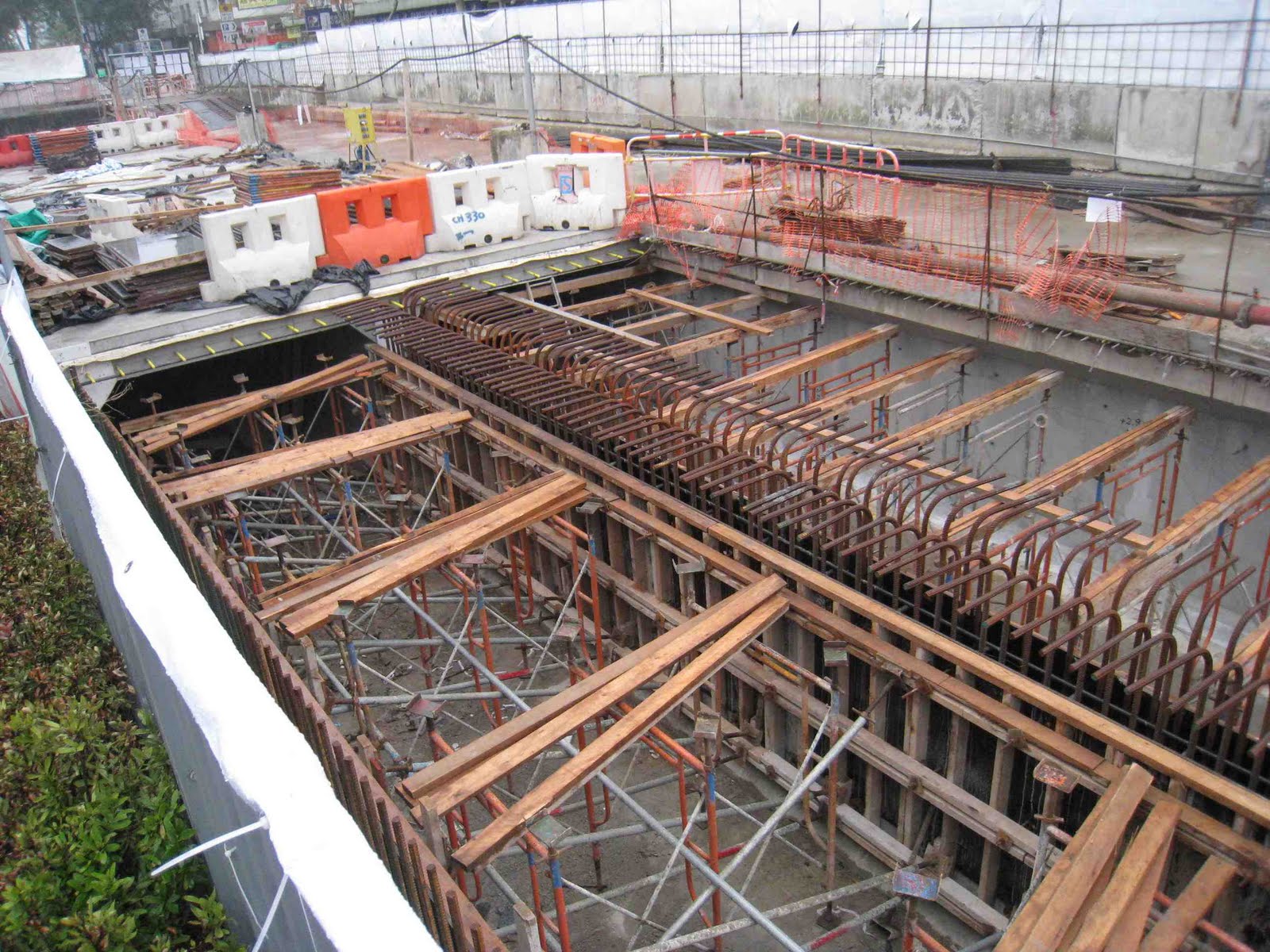
While the needy are deprived of a decent living, money is squandered on unnecessary projects. One example in Sai Kung is the covering of the stream between the police station and Fuk Man Street. The stream, sometimes a bit smelly during high tide but in no way a nuisance, is being covered by concrete slabs in what is a multimillion dollar, completely unnecessary project. I looked for an explanation and found a small sign (only in Chinese in an officially bilingual city) which showed a green patch with flowers on the concrete. While the starting and anticipated completion dates are stated, I saw no mention of the cost. In all the concretification that goes on in Hong Kong (slopes, paths, streams, hillsides), there is no sign which indicates the cost of each project. This should be mandatory so that we could raise an outcry on how our tax dollars are being wasted.


The construction site between the police station and Fuk Man Street.


On a happier note, I recently walked up to the High island Reservoir in Sai Kung Country Park, and came upon this breathtaking view. Now, this is one project which has benefited Hong Kong.


Tuesday, December 21, 2010

"Cooker" Wong RIP


Last month, I wrote about Cooker. Yesterday, when I returned to Hong Kong, I learned that he was found dead on the hillside behind the village. He had probably died on Saturday December 19.

Apparently, he was 86 years old and living by himself. His little trolley with some of the recyclable he had collected could be seen outside his humble home.

I saw Cooker everyday and will miss him. This is the second death in the village within the past two months. The village chief passed away in November, but he was ailing and more than 80 years old.

Monday, November 8, 2010

Cooker

We have nick names for various members of the Wong clan in our village. "The civil servant", "pipe smoker", "smiley" and the "village woman" are among the better known. Some of them have lived in the UK and have now returned home. Cooker is one such person.

We got used to seeing him around long before we had a nickname for him. He is the village scavenger, collecting anything--cardboard, metal, plastic, aluminium ware-- of any value, loading them on to his little trolley and trundling it down to Sai Kung town, a good 2 kms away. I once asked him how much he earned from each load, and he said $10. He speaks English but doesn't chat much with me. I did see him having a long chat with a Gweilo down the hill.

Smiley is the only villager who chats with us, sometimes in his halting but always interesting English. When I asked him about the old man, I was told that he had lived abroad. When I asked what he did, Smiley said "cooker". (He meant cook.) The nickname stuck.


Loading up his little trolley one morning. I once gave him a broken lap top computer and he was happy, saying he could get $100 for that.


Cooker lives in the dilapidated house which can be seen below. Other members of the clan have built newer houses, but he probably can't afford to do so.


Recently, Cooker had a bonanza. The village chief died and was buried in a plot up the hill. A few days later, the daughters-in-law began to throw out many of old Mr. Wong's possession, many of which ended up on Cooker's trolley to be sold down hill in Sai Kung.

Thursday, July 29, 2010

The office

Fung King Hey, Room 319

The desk has been cleared, the file cabinets and the shelves are empty, the computer is silent, and the A/C and lights have been switched off. My last day on campus will be on July 30, 2010.


But, this is what I look forward to. Not a bad trade off.